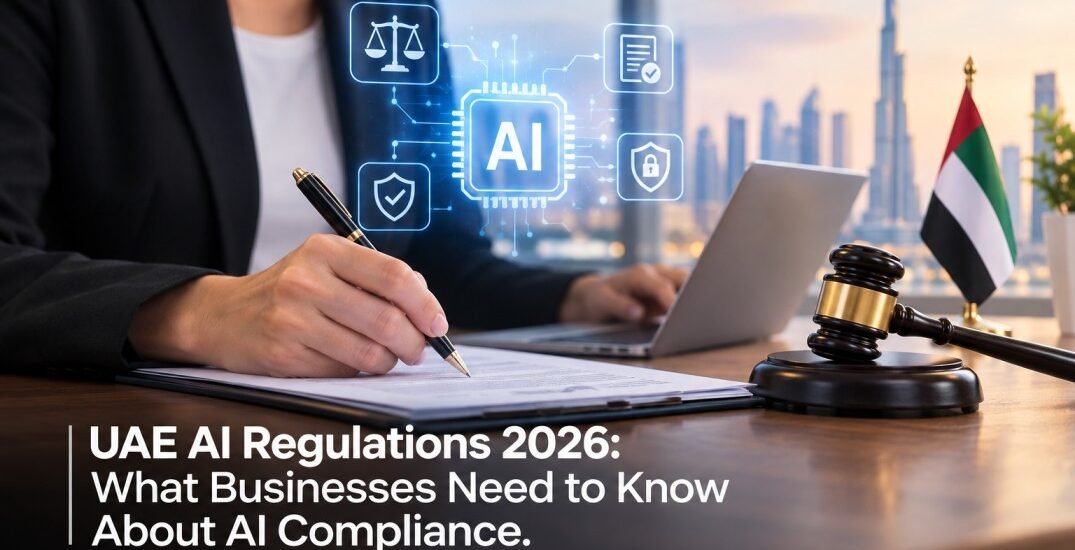
Understanding UAE AI regulations 2026 is becoming increasingly important for businesses as artificial intelligence is no longer something businesses can treat as a future technology. From customer service chatbots and automated marketing to data analysis, recruitment tools and AI-powered business software, companies across the UAE are already using AI in their daily operations.
As AI adoption grows, businesses also need to think about how these technologies are being used, what information they process and who is responsible for the results. This makes understanding UAE AI regulations 2026 increasingly important for companies that want to use AI while managing legal, privacy, cybersecurity and compliance risks.
The UAE has been actively developing policies and frameworks around responsible AI. Its approach focuses on innovation while also highlighting principles such as ethics, transparency, safety, accountability and privacy.
Understanding UAE AI regulations 2026
One important point for businesses is that there is not necessarily one single UAE federal law covering every possible use of artificial intelligence. Instead, AI governance can involve a combination of policies, existing laws, sector-specific requirements and regulatory frameworks.
For example, UAE government guidance identifies AI ethics, safety, transparency and privacy as important principles. Existing legislation relating to personal data protection and cybersecurity can also become relevant when an AI system collects, processes or stores personal information.
This means businesses should not look at AI compliance as simply obtaining an “AI licence.” The actual requirements can depend on the technology being used, the industry, the type of data involved and the jurisdiction in which the business operates.
Why AI compliance matters for UAE businesses
AI can make business operations faster, but careless implementation can create new risks.
Consider a company using an AI platform to analyse customer information. If the system processes personal data, the company needs to understand how that information is collected, stored, transferred and used. UAE data protection legislation may become relevant depending on the circumstances.
There can also be concerns around confidential business information. Employees may unknowingly enter sensitive company documents, customer details or financial information into publicly available AI tools.
Another issue is accuracy. AI-generated content or automated decisions can contain errors. Businesses therefore need appropriate human oversight, particularly when AI is being used for important business or customer-facing decisions.
Key areas businesses should review
When introducing AI into business operations, companies should review several areas.
1. Data privacy
Businesses should know exactly what data their AI systems process. Personal information should be handled in accordance with applicable UAE data protection requirements.
Companies should also understand whether an AI provider stores data outside the UAE and what contractual or security measures apply.
2. Transparency and accountability
AI should not become a “black box” where nobody knows who is responsible for its output.
The UAE’s AI policy framework highlights accountability, transparency and explainability as important principles for responsible AI.
Businesses should therefore establish clear internal responsibility for approving, monitoring and reviewing AI systems.
3. Cybersecurity
AI tools can create additional cybersecurity considerations, particularly when they connect to company systems, databases or customer platforms.
The UAE government maintains a National Cyber Security Policy for Artificial Intelligence alongside broader cybersecurity policies.
Businesses should therefore consider access controls, security testing, data protection and incident response when introducing AI solutions.
4. AI-generated content
Businesses increasingly use AI to create advertisements, articles, images, videos and other marketing materials.
Before publishing AI-generated content, companies should check for copyright concerns, inaccurate information, misleading claims and inappropriate use of third-party material.
Human review remains important even when content is generated automatically.
What should businesses do in 2026?
Businesses do not necessarily need to stop using AI. Instead, they should introduce a structured approach to AI governance.
Start by making a list of the AI tools currently being used across the organisation. This could include ChatGPT-style tools, AI marketing platforms, recruitment software, analytics systems and customer-service chatbots.
Next, identify what type of information each tool receives. Separate ordinary business information from confidential and personal data.
The company should then establish basic internal rules. Employees should know which AI tools they are allowed to use, what information they should never enter into those platforms and when human approval is required.
Companies should also review contracts with AI software providers. Pay attention to data processing, security, confidentiality, ownership and data retention provisions.
For businesses entering the UAE market, Business setup consultants UAE can also help entrepreneurs understand the broader business environment, licensing requirements and operational considerations before launching technology-driven businesses.
Why professional compliance support can help
AI compliance can become complicated when a company operates across multiple jurisdictions or uses several technology providers.
A business may need to consider corporate regulations, data protection, cybersecurity, contractual obligations and industry-specific requirements at the same time.
This is where Compliance consultants UAE can provide practical support. They can help businesses review their existing processes, identify potential compliance gaps and develop internal procedures suited to their operations.
Professional advice can be particularly useful for companies handling large amounts of customer data, financial information, healthcare information or other sensitive business records.
Preparing for the future
The UAE’s approach to AI continues to evolve alongside rapid technological development. In June 2026, the UAE approved the establishment of the Artificial Intelligence and Data Authority, signalling continued institutional development around AI and data governance.
For businesses, this means compliance should not be treated as a one-time exercise. Companies should regularly review their AI tools, policies and data practices as regulations and official guidance develop.
The practical goal is simple: use AI to improve business operations while making sure innovation does not come at the expense of privacy, security, transparency or accountability.
Understanding UAE AI regulations 2026 can therefore help businesses make better-informed decisions when adopting new AI technologies.
Frequently Asked Questions
Is there one AI law that applies to every UAE business?
Not necessarily. The UAE’s AI governance framework involves policies, guidelines and existing laws, while certain sectors and jurisdictions may have additional requirements. Businesses should assess their specific activities rather than assuming one rule applies to every AI use case.
Does data protection apply when a company uses AI?
It can. If an AI system processes personal information, applicable UAE data protection requirements may need to be considered. Businesses should understand what data is collected, why it is processed and how it is stored and transferred.
Should employees have an AI usage policy?
Yes. An internal AI policy can establish which tools employees may use, what information must not be entered into AI platforms and when human review is required.
Can AI-generated content be used for business marketing?
It can be used, but businesses should review the content before publishing it. Accuracy, confidentiality, intellectual property and misleading-content risks should all be considered.
Why should businesses monitor AI compliance regularly?
AI technology and regulatory expectations are developing quickly. Regular reviews can help businesses identify changes, update internal policies and reduce compliance risks as their use of AI expands.
Conclusion
AI offers UAE businesses opportunities to improve productivity, customer service and decision-making. But responsible adoption requires more than simply choosing an AI tool.
Companies should understand the data they process, establish clear responsibilities, protect confidential information and keep track of relevant regulatory developments.
As the UAE continues building its AI ecosystem, businesses that approach AI with both innovation and compliance in mind will be better prepared for the changing digital environment. For companies entering the market or reviewing their existing processes, professional Compliance consultants UAE can help turn regulatory requirements into practical business procedures.
Staying informed about UAE AI regulations 2026 is an important step toward using AI responsibly and confidently.
